
7 Best AI Research Agents in 2026 That Can Do Hours of Research in Minutes
Discover the best AI research agents that can analyze information, summarize sources, fact check content, and help students, marketers, creators, and businesses research smarter in 2026.
Introduction
Research has always been one of the most time consuming parts of learning, content creation, business planning, and decision making. Whether you are writing a blog post, preparing a presentation, analyzing a market, or studying for exams, finding reliable information often takes hours.
That is why AI research agents are becoming increasingly valuable in 2026. Unlike traditional AI chatbots that simply answer questions, research agents can search multiple sources, analyze information, compare findings, summarize large datasets, and even help verify facts.
Students use them to speed up assignments. Marketers use them to understand industry trends. Business owners use them to analyze competitors. Researchers use them to gather information more efficiently.
The key is knowing which tools are actually useful. Some AI tools provide surface level answers, while others can perform surprisingly deep research. This guide covers the best AI research agents available in 2026 and explains where each one performs best.

What Are AI Research Agents?
AI research agents are advanced artificial intelligence systems designed to gather, analyze, organize, and summarize information from multiple sources.
Unlike standard AI assistants, autonomous research agents can perform multi step research tasks with limited user input.a

For example, instead of asking:
“What is the future of remote work?”
You can ask:
“Research remote work trends, compare reports from major consulting firms, identify common patterns, and summarize the findings.”
A capable research agent can perform much of that process automatically.
This ability makes AI agents for research especially useful for professionals who regularly work with large amounts of information.
How AI Research Agents Work?
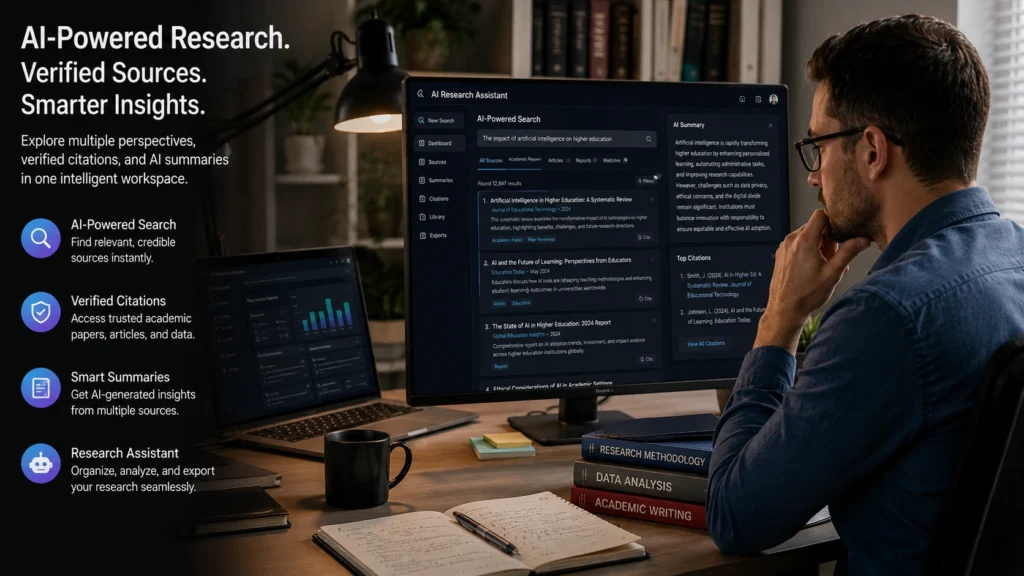
Most modern research agents combine several capabilities:
Information Gathering
They search websites, documents, databases, reports, and articles.
Source Analysis
They compare multiple sources rather than relying on a single answer.
Fact Verification
Many research agents identify supporting evidence and cite references.
Summarization
They condense lengthy information into clear, understandable insights.
Insight Generation
The best tools can identify patterns, trends, and conclusions that may not be obvious at first glance.
This combination dramatically reduces research time while improving efficiency.
7 Best AI Research Agents in 2026
1. ChatGPT Deep Research
ChatGPT’s Deep Research mode has become one of the most capable AI research agents available today.
Best For
- Market research
- Business analysis
- Long form content research
- Educational topics
- Competitive analysis
Practical Example
Imagine a marketing consultant researching AI adoption among small businesses.
Instead of opening twenty browser tabs manually, ChatGPT Deep Research can collect relevant information, summarize findings, compare sources, and generate a structured report.
Why It Stands Out?
It performs multi step reasoning while presenting information in a clear and organized format.

2. Perplexity
Perplexity has become a favorite among students, journalists, and researchers who value transparency.
Best For
- Fast research
- Fact checking
- Source verification
- Current events research
Mini Case Study
A university student preparing a research paper can quickly gather source backed information and access citations directly without spending hours searching manually.
Why It Stands Out?
Every answer includes source references, making verification easier.
3. Gemini Deep Research
Google’s Gemini Deep Research focuses heavily on comprehensive web research.
Best For
- Industry reports
- Market trends
- Technology research
- Large research projects
Practical Use
Business professionals often use Gemini to investigate emerging industries and gather information from diverse sources.
Why It Stands Out?
Strong integration with Google’s search ecosystem allows access to broad information coverage.

4. Claude
Claude is particularly effective when working with long documents.
Best For
- Research papers
- PDFs
- Reports
- Academic analysis
Example
A researcher reviewing a 200 page industry report can upload the document and ask Claude to extract key findings, trends, and conclusions.
Why It Stands Out?
Its ability to process large amounts of text makes it highly valuable for document based research.

5. Elicit
Elicit was specifically designed for academic research.
Best For
- Scientific studies
- Literature reviews
- Academic papers
- Research summaries
Mini Case Study
A graduate student preparing a thesis can use Elicit to identify relevant studies, compare findings, and organize supporting evidence.
Why It Stands Out?
It focuses heavily on evidence based research rather than general web content.
6. Consensus
Consensus helps users find answers directly from scientific research.
Best For
- Health research
- Scientific questions
- Evidence based decision making
- Academic studies
Practical Example
Instead of reading dozens of scientific papers individually, users can quickly understand what existing research suggests about a topic.
Why It Stands Out?
Its answers are built around published research rather than general internet opinions.
7. You.com Research Agent
You.com has evolved from a search engine into a capable research assistant.
Best For
- Competitive research
- Business intelligence
- Web research
- Information gathering
Practical Use
Marketing teams often use it to collect competitor insights, industry news, and market developments.
Why It Stands Out?
It combines AI analysis with real time information retrieval.

Who Should Use AI Agents for Research?
Students
Students can use research agents to:
- Summarize textbooks
- Find sources
- Understand complex topics
- Prepare assignments
Content Creators
Creators benefit from:
- Topic research
- Fact checking
- Trend analysis
- Content planning
Business Professionals
Professionals often use research agents for:
- Competitor analysis
- Market research
- Industry reports
- Strategic planning
Researchers
Researchers use AI tools to:
- Review literature
- Analyze findings
- Organize information
- Save time during early research phases
Common Mistakes When Using AI Tools for Research
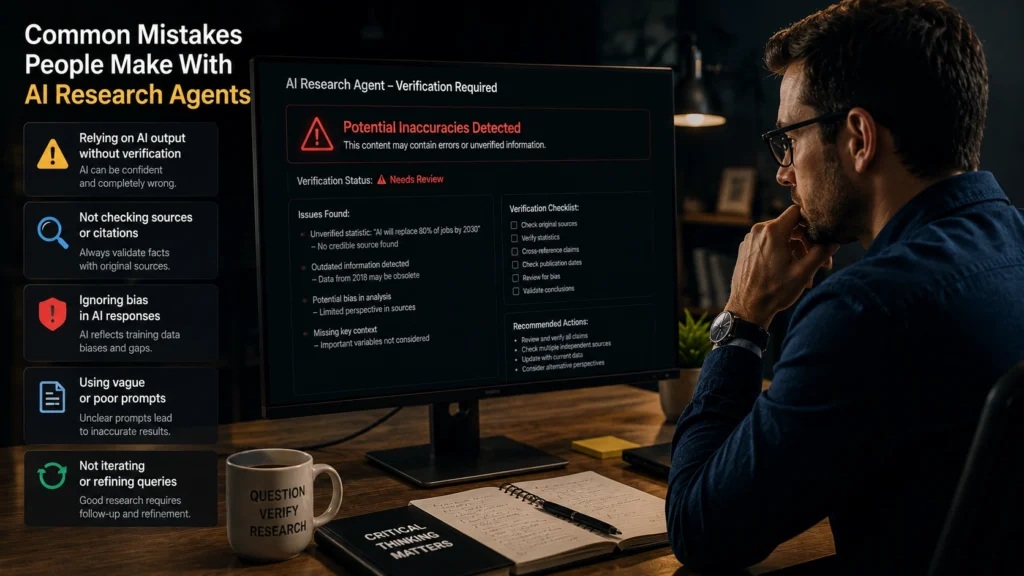
Trusting Every Output Automatically
AI can make mistakes.
Always verify important information using reliable sources.
Using Only One Source
Research quality improves when information comes from multiple perspectives.
The best AI research agents help compare various sources.
Ignoring Context
Facts without context can be misleading.
Always understand where information came from and how it applies to your specific situation.
Replacing Critical Thinking
AI should support analysis, not replace it.
Human judgment remains essential for making informed decisions.
Best Practices for Researching With AI
Start With Specific Questions
The better your prompt, the better the research output.
Instead of asking:
“Tell me about artificial intelligence.”
Ask:
“Compare how small businesses are using AI for customer support in 2026.”
Request Sources
Whenever possible, ask AI tools to provide citations and references.
This improves trust and makes verification easier.
Cross Check Important Findings
For academic, business, legal, or financial decisions, always review original sources.
Combine Multiple Research Agents
Many professionals use different tools for different purposes.
For example:
- Perplexity for source discovery
- Claude for document analysis
- Elicit for academic studies
- ChatGPT Deep Research for final synthesis
This often produces stronger results than relying on a single tool.
Frequently Asked Questions
What are AI research agents?
AI research agents are advanced AI systems that gather, analyze, summarize, and organize information from multiple sources to help users conduct research more efficiently.
What are the best AI research agents in 2026?
Some of the best AI research agents include ChatGPT Deep Research, Perplexity, Gemini Deep Research, Claude, Elicit, Consensus, and You.com Research Agent.
Are AI agents for research accurate?
Many AI agents provide highly useful information, but users should always verify important facts using trusted sources.
Can students use AI tools for research?
Yes. Students commonly use AI tools for research to summarize information, discover sources, understand difficult concepts, and organize study materials.
Are autonomous research agents replacing researchers?
No. They help automate information gathering and analysis, but critical thinking, interpretation, and decision making still require human expertise.
Conclusion
AI research agents are changing how people gather and analyze information. Tasks that once required hours of searching, reading, and organizing can now be completed much faster with the right tools.
Whether you are a student preparing assignments, a marketer researching trends, a creator fact checking content, or a professional analyzing an industry, these tools can significantly improve efficiency.
The most effective approach is not to rely on AI blindly. Instead, use it as a research partner that helps you work smarter while keeping human judgment at the center of the process.
As these systems continue improving, research will become less about finding information and more about understanding what that information actually means.

Interested in discovering more practical AI tools, research platforms, productivity software, and emerging AI trends? Explore more expert guides and resources on your AI journey and stay updated with the latest developments shaping the future of work and learning.