
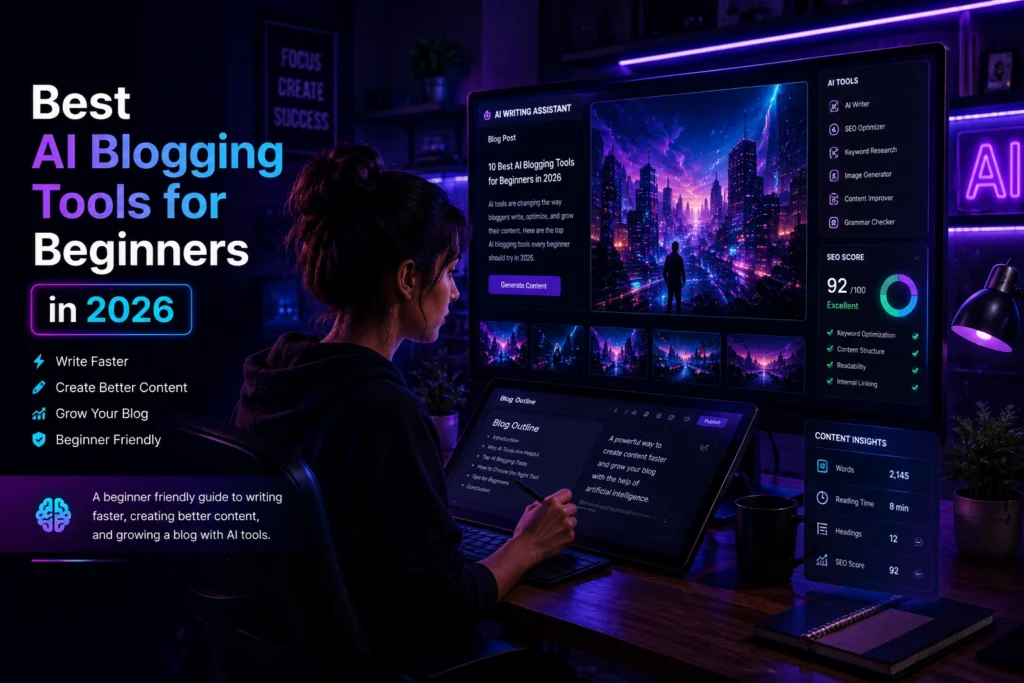
Best AI Blogging Tools for Beginners in 2026
A Beginner Friendly Guide to Writing Faster, Creating Better Content, and Growing a Blog With AI Tools
Introduction
Starting a blog in 2026 is easier than it was a few years ago, but growing one still takes time, consistency, and smart content planning. That is exactly why more creators are using ai blogging tools to speed up their workflow without lowering quality.
AI tools can help beginners write faster, organize ideas, improve SEO, create blog images, and manage research more efficiently. However, successful blogging still depends on human creativity, experience, and understanding your audience.
Many new bloggers make the mistake of depending entirely on automation. The bloggers who usually grow faster are the ones who use AI as an assistant instead of a replacement. When used correctly, AI can save hours every week while helping you publish more useful content consistently.
In this guide, you will learn how to use AI for blogging, which tools are actually helpful for beginners, and how to avoid common mistakes that hurt rankings and trust.
Table of Contents
- Why Bloggers Are Using AI in 2026?
- What AI Blogging Tools Actually Do?
- Best AI Writing Tools for Bloggers
- How AI Helps With SEO Content?
- Using AI for Blog Images and Design
- AI Tools for Research and Productivity
- Common Mistakes Bloggers Make With AI
- Best Practices for Blogging With AI
- Can AI Blogs Rank on Google?
- The Future of AI Blogging
- FAQs
- Conclusion
Why Bloggers Are Using AI in 2026?
Blogging has become more competitive. Readers expect better formatting, faster answers, clearer explanations, and visually engaging content. At the same time, search engines reward useful and well structured content.
This is where AI tools help.
Instead of spending four hours writing a rough draft, bloggers can now generate outlines, brainstorm headlines, improve readability, and organize research within minutes.

For example, a beginner running a small tech blog may use AI to:
- Generate blog topic ideas
- Create article outlines
- Rewrite unclear paragraphs
- Find SEO keyword suggestions
- Design featured images
- Summarize research notes
That does not mean AI writes perfect content automatically. In fact, most successful bloggers still spend time editing, fact checking, and adding personal insights.
AI simply removes repetitive tasks so creators can focus more on quality.
What AI Blogging Tools Actually Do?
Many beginners assume AI tools only write articles. In reality, modern ai content creation tools do much more than that.
Content Writing Assistance
AI writing tools help with:
- Creating introductions
- Improving readability
- Expanding ideas
- Fixing grammar
- Rewriting awkward sentences
These features are especially useful for beginners who struggle with writer’s block.
SEO Optimization
Some AI tools analyze search intent and suggest:
- Better headings
- Related keywords
- Internal linking ideas
- Content gaps
- Readability improvements
This helps bloggers create articles that are easier for both readers and search engines to understand.
Visual Content Creation
AI image tools can generate:
- Blog banners
- Featured images
- Infographics
- Social media graphics
Visual content keeps readers engaged longer, which may improve user behavior signals over time.
Best AI Writing Tools for Bloggers
There are hundreds of writing tools available now, but beginners should focus on tools that are simple and practical.
OpenAI
ChatGPT remains one of the best ai tools for blogging because it works well for brainstorming, outlining, rewriting, and explaining complex topics in simple language.
Many bloggers use it to:
- Build article structures
- Generate topic clusters
- Improve introductions
- Create FAQ ideas
A practical approach is to write your own ideas first and then use ChatGPT to improve clarity and flow.
Grammarly
Grammarly helps bloggers improve grammar, tone, and readability. It is particularly useful for beginners who want cleaner writing without hiring an editor.
One useful feature is sentence clarity suggestions. These often help remove unnecessary complexity.
Notion
Notion AI works well for organizing blog workflows. Bloggers use it for:
- Content calendars
- Research notes
- Topic databases
- Draft organization
It combines productivity and writing support in one place, which many solo bloggers find helpful.

How AI Helps With SEO Content?
SEO has changed significantly in recent years. Search engines now focus heavily on helpful content and real expertise.
AI tools can support SEO workflows when used correctly.
Keyword Research Support
AI tools help identify:
- Related search terms
- Question based keywords
- Long tail phrases
- Content opportunities
For example, instead of targeting only “ai blogging tools,” bloggers may also create sections around:
- how to use ai for blogging
- ai content creation tools
- best ai tools for blogging
This improves semantic relevance naturally.

Content Structure Improvements
Well structured articles are easier to rank because readers can scan them quickly.
AI tools often suggest:
- Clear headings
- Better formatting
- FAQ sections
- Featured snippet opportunities
However, relying fully on automation often creates generic articles that sound repetitive.
The best results usually come from combining AI assistance with human editing and real examples.
Using AI for Blog Images and Design
Visual content matters more than many beginners realize.
A plain article without images often feels harder to read. Good visuals improve engagement and make blog posts look more professional.
AI Image Generators
Popular AI image tools help bloggers create:
- Custom thumbnails
- Blog banners
- Concept art
- Social graphics
This is especially useful for new bloggers who cannot afford professional design services.

Design Tools for Bloggers
Tools like Canva, Canva make it easier to create:
- Pinterest graphics
- Blog headers
- Infographics
- Social media posts
AI Tools for Research and Productivity
Research takes a huge amount of time during blogging.
AI productivity tools help simplify information gathering and organization.
Research Assistance
AI research tools can summarize:
- Articles
- Reports
- Videos
- PDFs
This saves time during content planning.
However, bloggers should always verify facts manually before publishing.
Productivity Benefits
Bloggers also use AI for:
- Task management
- Content scheduling
- Note organization
- Workflow automation
A beginner managing a blog alone may save several hours every week simply by organizing work more efficiently.

Common Mistakes Bloggers Make With AI
AI tools are helpful, but many beginners use them incorrectly.
Publishing Unedited AI Content
One major mistake is copying AI generated text directly into a blog without editing.
This often creates:
- Generic explanations
- Incorrect information
- Repetitive wording
- Weak originality
Readers usually notice when content lacks human experience.
Ignoring Personal Insight
Blogs perform better when they include opinions, examples, and practical experience.
For instance, instead of saying “AI tools improve productivity,” explain how a specific tool reduced your content planning time.
That creates stronger trust signals.
Overusing Keywords
Some beginners stuff keywords unnaturally throughout articles.
Modern SEO works better when keywords appear naturally within useful content.
Best Practices for Blogging With AI
The smartest bloggers treat AI as a support tool, not an automatic content machine.
Start With Human Ideas
Begin with:
- Your audience questions
- Personal observations
- Real problems readers face
Then use AI to organize and improve the information.
Always Edit Thoroughly
Review every article for:
- Accuracy
- Readability
- Tone
- SEO structure
Even strong AI drafts still need human refinement.
Add Experience Based Insights
Google increasingly values experience driven content.
Small additions such as personal workflows, testing results, or lessons learned make articles feel more trustworthy.
Can AI Blogs Rank on Google?
Yes, AI assisted blogs can rank well on Google.
Google does not ban AI content simply because AI was involved. What matters most is content quality and usefulness.
Helpful articles that provide:
- Accurate information
- Original insights
- Clear structure
- Good user experience
can perform very well in search results.
On the other hand, low quality AI spam content usually struggles because it lacks originality and real value.
The key difference is human involvement.
The Future of AI Blogging
AI blogging tools will continue improving in areas such as:
- Content research
- Topic clustering
- Voice based drafting
- Visual content generation
- SEO analysis
At the same time, human creativity will remain important.
Readers still connect more with authentic opinions, practical experience, and relatable storytelling.
The bloggers who grow successfully over the next few years will likely be the ones who combine AI efficiency with genuine expertise.
FAQs
What are the best AI blogging tools for beginners?
Some beginner friendly options include ChatGPT, Grammarly, Notion AI, and Canva. These tools help with writing, editing, research, and visual content creation.
How do bloggers use AI for content creation?
Bloggers use AI for brainstorming, outlining, SEO optimization, grammar correction, image generation, and workflow organization.
Can AI written blogs rank on Google?
Yes. AI assisted blogs can rank if the content is accurate, useful, original, and properly edited by humans.
Is AI blogging good for SEO?
AI can support SEO by improving keyword research, content structure, readability, and topic coverage. However, quality still matters most.
Should beginners rely completely on AI writing tools?
No. AI should support the writing process, not replace human creativity and editing completely.
Conclusion
Using ai blogging tools in 2026 can make content creation faster and more manageable, especially for beginners trying to grow a blog consistently. From writing assistance to SEO optimization and visual design, AI tools now support almost every part of the blogging process.
Still, the most successful blogs are rarely built through automation alone. Readers trust content that feels helpful, authentic, and experience driven. That human element remains important no matter how advanced AI becomes.
If you are learning how to use AI for blogging, start small. Experiment with a few tools, focus on improving content quality, and build a workflow that helps you stay consistent without losing your personal voice.

If you are exploring the best ai tools for blogging, try testing one or two tools first instead of using everything at once. A simple workflow often works better than a complicated one, especially when you are just starting your blogging journey.
Want more AI tools, tutorials, and creator resources?
Visit AI With Sahil for practical AI guides, tool comparisons, and beginner friendly tutorials.