

ChatGPT for Students: 15 Smart Ways to Study Better in 2026
Learn how students can use ChatGPT to improve learning, save time, stay organized, and study more effectively with practical examples and prompts.
Introduction
Being a student has never been easy. Between lectures, assignments, projects, exams, and personal responsibilities, it often feels like there are not enough hours in the day. Many students spend more time organizing their study materials than actually learning them.
This is where ChatGPT for students has become surprisingly useful. Instead of replacing learning, it can act as a study partner that helps explain difficult concepts, organize information, generate practice questions, and improve productivity. When used correctly, ChatGPT can help students study smarter rather than simply studying longer.
The key is understanding how to use it effectively. In this guide, you will discover 15 practical ways students are using ChatGPT in 2026, along with useful prompts, common mistakes to avoid, and best practices that can make studying more efficient.
Why Students Are Using ChatGPT in 2026?
The modern student faces a unique challenge. There is more information available than ever before, yet finding the right information quickly can be difficult.
Many students use ChatGPT because it helps simplify complex topics and saves time during research and revision.
Instead of spending thirty minutes searching through websites for a basic explanation, students can ask direct questions and receive structured answers instantly.
However, successful students do not use ChatGPT to avoid learning. They use it to make learning more efficient.

ChatGPT for Students: 15 Smart Ways to Study Better
1. Simplify Difficult Topics
Some subjects can feel overwhelming when textbooks use technical language.
ChatGPT can explain concepts in simpler terms.
Example Prompt
“Explain photosynthesis like I am a first year college student.”
This works particularly well for science, economics, mathematics, and technology subjects.
2. Create Personalized Study Notes
Students often spend hours rewriting lecture notes.
ChatGPT can organize information into cleaner summaries.
Example Prompt
“Summarize these class notes into key points for revision.”
This helps reduce revision time significantly.
3. Generate Practice Questions
Testing yourself is one of the most effective ways to learn.
Example Prompt
“Create 20 multiple choice questions based on these notes.”
This approach improves retention and identifies weak areas before exams.
4. Build a Study Schedule
Many students struggle with consistency rather than intelligence.
ChatGPT can create realistic study plans based on available time.
Example Prompt
“Create a four week exam preparation schedule for Biology and Chemistry.”
5. Understand Research Papers Faster
Academic papers can be difficult to read.
Students can paste sections and ask for summaries.
Example Prompt
“Summarize this research paper and explain the key findings in simple language.”
This is especially useful for university students.
6. Improve Essay Writing
ChatGPT can help students organize ideas before writing.
Example Prompt
“Create an essay outline about climate change and renewable energy.”
The outline can then be expanded using the student’s own understanding.
7. Learn Through Questions
One effective learning method is active questioning.
Example Prompt
“Ask me questions about World War II and increase difficulty after each answer.”
This creates an interactive learning experience.
8. Turn Notes Into Flashcards
Flashcards remain one of the best revision tools.
Example Prompt
“Convert these notes into flashcards with questions and answers.”
Many students use this technique before exams.
9. Get Homework Guidance
Students sometimes get stuck on assignments.
ChatGPT can provide guidance without directly giving answers.
Example Prompt
“Help me understand how to solve this problem step by step.”
Learning the process is more valuable than copying solutions.
10. Practice Language Skills
Language learners can use ChatGPT as a conversation partner.
Example Prompt
“Practice Spanish conversation with me and correct my mistakes.”
This provides instant feedback.
11. Prepare for Presentations
Public speaking can be stressful.
ChatGPT can help organize presentation structures.
Example Prompt
“Create a five minute presentation outline about artificial intelligence.”
12. Brainstorm Project Ideas
Students often spend too much time choosing project topics.
Example Prompt
“Suggest unique project ideas related to renewable energy.”
Fresh ideas can help students stand out academically.
13. Learn Time Management Skills
Good grades often come from good habits.
Example Prompt
“Help me build a daily routine that balances classes, study time, exercise, and rest.”
This supports long term productivity.
14. Review Before Exams
Exam preparation becomes easier when information is condensed.
Example Prompt
“Create a one page revision sheet from these notes.”
This method works particularly well for final reviews.
15. Identify Knowledge Gaps
Students often assume they understand topics better than they actually do.
Example Prompt
“Quiz me on this topic and identify areas where I need improvement.”
This can reveal weaknesses before exams.
Best ChatGPT Prompts for Students
Here are some practical chatgpt prompts for students that can be used immediately:
For Learning Concepts
“Explain this topic using simple examples.”
For Revision
“Summarize this chapter into key exam points.”
For Productivity
“Create a study plan for the next 30 days.”
For Research
“Explain the main arguments from this research paper.”
For Exam Preparation
“Generate difficult exam style questions on this topic.”
These prompts help students get more useful responses instead of generic answers.
Mini Case Study: How a Student Improved Study Efficiency
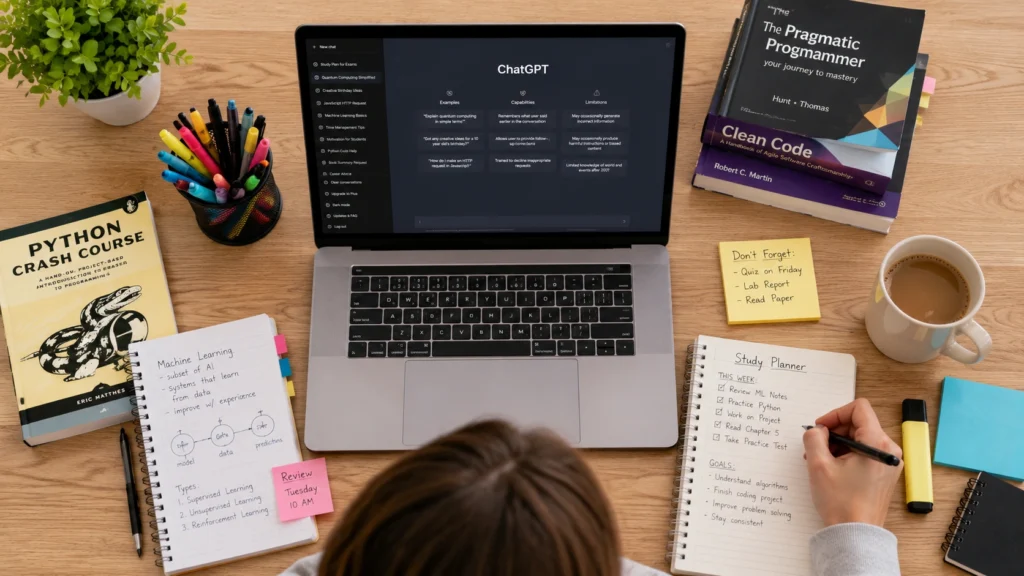
Consider a university student preparing for final exams while managing a part time job.
Before using ChatGPT, they spent several hours each week organizing notes, creating revision questions, and planning study sessions.
After using ChatGPT as a study assistant, they automated note summaries, generated practice quizzes, and created structured revision schedules.
The result was not necessarily studying more hours. Instead, it was spending more time actively learning and less time preparing to learn.
That distinction matters.
Common Mistakes Students Make
Using ChatGPT as a Shortcut
Some students ask for complete assignments and submit them without understanding the content.
This may save time temporarily, but it hurts learning.
Trusting Every Response
ChatGPT can occasionally provide inaccurate information.
Students should verify important facts using textbooks, academic sources, and instructors.
Asking Vague Questions
Poor prompts usually produce poor results.
Specific questions generally lead to better answers.

Best Practices for Using ChatGPT as a Study Assistant
Think of ChatGPT as a tutor rather than an answer machine.
The goal is understanding.
Combine Multiple Sources
Use textbooks, lectures, research papers, and ChatGPT together.
This creates stronger learning outcomes.
Practice Active Learning
Ask questions, solve problems, and test your knowledge regularly.
Passive reading is rarely enough.
Review Information Critically
Always evaluate responses rather than accepting them automatically.
Critical thinking remains one of the most valuable academic skills.

Frequently Asked Questions
Is ChatGPT good for students?
Yes. ChatGPT can help students understand concepts, organize notes, create study schedules, generate practice questions, and improve productivity.
How can students use ChatGPT for studying?
Students can use ChatGPT for revision, research summaries, flashcards, essay planning, exam preparation, and learning difficult concepts.
What are the best ChatGPT prompts for students?
Some effective prompts include creating study plans, summarizing notes, generating quizzes, explaining concepts, and producing revision materials.
Can ChatGPT help students prepare for exams?
Yes. It can create mock tests, revision summaries, flashcards, and practice questions that support exam preparation.
Is ChatGPT a reliable study assistant?
It can be useful, but students should always verify important information from trusted academic sources.
Conclusion
ChatGPT for students is most effective when it supports learning rather than replaces it. The students who benefit the most are usually those who use it to organize information, understand difficult concepts, test knowledge, and improve study habits.
Used thoughtfully, ChatGPT can save time, reduce academic stress, and make studying more efficient. However, real learning still comes from curiosity, practice, and critical thinking.
Technology can help guide the process, but your understanding is what ultimately leads to success.

Looking for more practical AI guides, study resources, and productivity tips? Explore more educational content on AI With Sahil and discover new ways to learn smarter in 2026.