
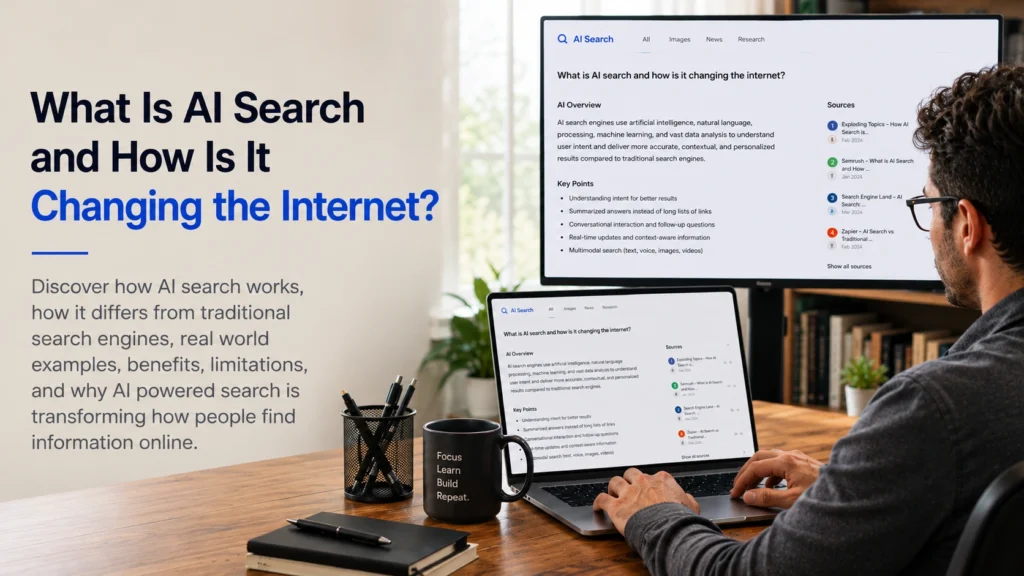
What Is AI Search and How Is It Changing the Internet?
Discover how AI search works, how it differs from traditional search engines, real world examples, benefits, limitations, and why AI powered search is transforming how people find information online.
Introduction
A few years ago, finding information online usually meant typing a few keywords into a search engine and scrolling through pages of links. Today, that experience is changing rapidly. Instead of simply showing websites, modern search systems can understand questions, summarize information, compare sources, and provide direct answers.
If you have recently used tools like Perplexity AI, OpenAI ChatGPT Search, or AI Overviews in Google Search, you have already experienced this shift firsthand.
Many people are now asking: what is AI search, and why does it seem so different from traditional search engines?
The answer is simple. AI search combines search technology with artificial intelligence to understand intent, process information, and provide more useful answers. As a result, students, researchers, professionals, and everyday internet users are discovering faster ways to find information without opening dozens of tabs.
Table of Contents
- What Is AI Search?
- How AI Search Works?
- AI Search vs Traditional Search Engines
- Real World AI Search Examples
- Best AI Search Tools in 2026
- Benefits of AI Search
- Limitations of AI Search
- How AI Search Is Changing the Internet?
- Common Mistakes People Make With AI Search
- Best Practices for Using AI Search
- FAQs
- Conclusion
What Is AI Search?
AI search is a search method that uses artificial intelligence to understand user questions and provide more relevant answers.
Instead of matching keywords alone, AI search attempts to understand meaning, context, intent, and relationships between concepts.
Traditional Search Example
A user searches:
“Best laptops for college students.”
A traditional search engine returns:
- Review websites
- Product pages
- Buying guides
- Forum discussions
The user then reads multiple sources to find an answer.

AI Search Example
The same query in an AI search engine may return:
- Recommended laptop categories
- Key buying factors
- Price comparisons
- Pros and cons
- A summarized answer
All in one response.
This difference explains why AI search is attracting so much attention.
How AI Search Works?
Understanding how AI search works becomes easier when we break the process into simple steps.
Step 1: Understanding the Question
AI systems analyze the user’s query to understand intent rather than focusing only on keywords.
For example:
“What is the best laptop for engineering students under $1000?”
The system understands:
- Laptop
- Engineering student
- Budget under $1000
- Performance requirements
That context helps improve answer quality.

Step 2: Finding Relevant Information
The AI system searches across databases, websites, documents, and indexed content to gather information related to the query.
Unlike traditional search, the goal is not only finding matching pages but also finding useful information.
Step 3: Processing the Information
Large language models analyze the gathered content.
The AI identifies:
- Main ideas
- Patterns
- Relationships
- Key facts
- Supporting evidence
Step 4: Generating an Answer
The final step is presenting information in a readable format.
Instead of giving only links, AI search often provides:
- Summaries
- Comparisons
- Explanations
- Recommendations
- Follow up suggestions
This creates a more conversational search experience.
AI Search vs Traditional Search Engines
Many people assume AI search engines will completely replace traditional search. The reality is more nuanced.
| Traditional Search | AI Search |
|---|---|
| Returns website links | Returns direct answers |
| Relies heavily on keywords | Understands intent |
| User gathers information manually | AI summarizes information |
| Requires multiple searches | Often solves questions faster |
| Excellent for broad web exploration | Excellent for research and explanations |

Both approaches still have value.
Traditional search remains useful when users want original sources, news articles, product pages, or detailed website exploration.
AI search works best when users need explanations, summaries, comparisons, or research assistance.
Real World AI Search Examples
Research and Education
A university student researching climate change can ask:
“Explain climate change causes in simple language and provide scientific sources.”
The AI delivers:
- A simplified explanation
- Key factors
- Source references
- Suggested follow up questions
This reduces research time significantly.

Workplace Productivity
A marketing professional might ask:
“Summarize current email marketing trends for small businesses.”
Instead of reading twenty articles, the AI creates a concise overview.
Technical Learning
Developers often use AI search examples for coding assistance.
They can ask:
“Explain API authentication with practical examples.”
The AI provides explanations tailored to the user’s level of understanding.
Best AI Search Tools in 2026
Several platforms are leading the AI search movement.
Perplexity AI
It focuses heavily on source based answers and research.
Strengths:
- Citations
- Research summaries
- Fast answers
ChatGPT Search
It combines conversational AI with web search capabilities.
Strengths:
- Natural conversations
- Detailed explanations
- Follow up questions
Google AI Search Features
Google now includes AI generated summaries and AI Overviews for many searches.
Strengths:
- Massive search index
- Fresh information
- Strong web coverage
Microsoft Copilot Search
It integrates AI search into Microsoft’s ecosystem.
Strengths:
- Productivity integration
- Research support
- Web information retrieval

Benefits of AI Search
Faster Information Discovery
Users spend less time opening multiple pages.
Better Understanding
AI can simplify difficult concepts.
This is especially helpful for students and beginners.
Personalized Explanations
Different users need different levels of detail.
AI search can adapt responses based on context.
Improved Research Efficiency
Researchers often use AI to summarize large amounts of information before reviewing original sources.
This speeds up the discovery process.
Limitations of AI Search
AI search is powerful, but it is not perfect.
Incorrect Information
AI systems can occasionally generate inaccurate answers.
Fact checking remains important.
Missing Context
Some topics require deeper expertise or nuanced understanding.
AI may oversimplify complex issues.
Over Reliance
Users should not treat AI answers as unquestionable facts.
Critical thinking remains essential.
How AI Search Is Changing the Internet?
The internet was originally built around finding pages.
AI search shifts the focus toward finding answers.
This change affects:
Content Creators
Publishers now need content that demonstrates expertise, originality, and trustworthiness.
Businesses
Companies must optimize content not only for search rankings but also for AI generated answers.
Users
People expect faster, clearer, and more conversational experiences.
This trend is likely to continue over the coming years.

Common Mistakes People Make With AI Search
Accepting Every Answer Without Verification
AI responses should be checked against trusted sources when accuracy matters.
Asking Vague Questions
Better questions usually produce better answers.
Specific prompts improve results significantly.
Ignoring Source Citations
Reliable AI search tools often provide sources.
Reviewing those sources improves trust and understanding.

Best Practices for Using AI Search
Ask Detailed Questions
Instead of:
“Tell me about electric cars.”
Try:
“Compare electric cars and hybrid cars for city driving.”
Verify Important Information
Always cross check:
- Medical advice
- Financial information
- Legal guidance
- Academic research
Use Follow Up Questions
One major advantage of AI search is conversation.
Users can refine answers through additional questions.
This often leads to better insights.
Frequently Asked Questions
What is AI search?
AI search uses artificial intelligence to understand user intent, find information, and provide direct answers instead of only showing website links.
How does AI search work?
AI search analyzes a question, gathers relevant information, processes it using language models, and generates a helpful response.
Are AI search engines replacing traditional search engines?
Not completely. AI search and traditional search currently work best together because each has different strengths.
What are the best AI search tools in 2026?
Popular options include Perplexity AI, ChatGPT Search, Google AI Search features, and Microsoft Copilot.
Is AI search accurate?
AI search can be highly useful, but users should verify important information because inaccuracies can still occur.
Conclusion
Understanding what is AI search becomes easier when you see it as the next step in how people interact with information online. Instead of spending time sorting through countless links, users can now receive explanations, summaries, comparisons, and research assistance in a more natural way.
AI search is not replacing human judgment, nor is it making traditional search engines obsolete. Instead, it is changing expectations around speed, convenience, and accessibility.
As AI technology continues to improve, the ability to find and understand information will likely become faster, more personalized, and more conversational than ever before.

Interested in learning more about AI tools, productivity software, AI agents, and emerging technology trends? Explore more practical guides and tutorials on AI With Sahil and stay updated with the latest developments shaping the future of AI.