

Best AI Agent Tools in 2026
The Best AI Agents for Productivity, Automation, Business Workflows, and Everyday Tasks
Introduction
A few years ago, most AI tools could only answer questions, generate content, or help with simple tasks. In 2026, things look very different. AI agents can now plan actions, complete multi step workflows, gather information, make decisions based on instructions, and perform tasks with minimal supervision.
That shift is why more people are looking for practical AI systems that can complete tasks independently.
Whether you are a creator managing content, a student organizing research, or a business owner handling repetitive processes, AI agents can save time and reduce manual work.
The real value of AI agents is not that they think for you. It is that they handle routine work so you can focus on higher value decisions. In this guide, we will explore the best AI agents in 2026, how they work, who they are best suited for, and what you should know before adding them to your workflow.
Table of Contents
- What Are AI Agents?
- Why AI Agents Matter in 2026?
- Best AI Agent Tools in 2026
- How AI Agents Work Behind the Scenes?
- Best AI Browser Agents
- Real World Use Cases for Creators, Students, and Professionals
- Common Mistakes People Make With AI Agents
- Best Practices for Using Agentic AI Tools
- Frequently Asked Questions
- Conclusion
What Are AI Agents?
AI agents are software systems designed to complete tasks independently based on goals rather than single prompts.
Traditional AI usually responds to one request at a time. AI agents can take a goal, break it into steps, gather information, execute actions, and adjust based on results.
For example:
A traditional AI tool might help you write an email.
An AI agent might:
- Research the recipient
- Draft the email
- Schedule the follow up
- Track responses
- Update your workflow automatically

That ability to perform multiple connected tasks is what separates modern AI agents from standard AI assistants.
Why AI Agents Matter in 2026?
The amount of information people manage every day keeps growing.
Creators manage content calendars.
Students manage assignments and research.
Businesses manage emails, projects, meetings, and customer communication.
As workloads increase, people need systems that do more than provide answers.
AI agents help by:
- Automating repetitive work
- Managing workflows
- Organizing information
- Monitoring tasks
- Assisting with decision making
- Improving efficiency

Many industry experts believe agentic AI tools will become a normal part of daily work over the next few years.
The goal is not replacing people.
The goal is reducing busy work.
Many of these AI agents are built on automation systems that connect apps and workflows together. To understand the foundation behind these systems, explore our guide on Best AI Automation Tools in 2026.
Best AI Agent Tools in 2026
ChatGPT Operator
OpenAI continues expanding beyond conversations through agent based capabilities such as Operator.
Operator can interact with websites, complete tasks, gather information, and help users automate online activities.
Best For
- Research
- Productivity
- Personal assistance
- Workflow support
Practical Example
A creator can ask the system to research competitors, collect information, summarize findings, and prepare a content brief.
Instead of spending several hours gathering information manually, much of the process becomes automated.
Claude
Anthropic has become popular among professionals who need reliable reasoning and long context understanding.
Claude excels when handling large documents and complex projects.
Best For
- Research
- Writing
- Knowledge management
- Document analysis
Mini Case Study
A student working on a lengthy research project can upload multiple papers and receive structured summaries that help organize ideas faster.
Many users appreciate Claude because it often handles long information streams more naturally than traditional AI tools.
Manus AI
Manus gained attention for performing tasks with a higher degree of autonomy.
Instead of simply answering questions, it attempts to complete objectives independently.
Best For
- Workflow automation
- Research projects
- Data gathering
- Business processes
Industry Insight
The rise of tools like Manus shows where the AI industry is heading. Companies increasingly want AI systems that complete work rather than simply provide suggestions.

AutoGPT
AutoGPT remains one of the most discussed AI agent tools among developers and automation enthusiasts.
It allows users to create goal driven autonomous workflows.
Best For
- Technical users
- Experimentation
- Process automation
- Custom workflows
Example
A user could create an agent that continuously researches a topic, gathers updates, organizes findings, and generates reports automatically.
CrewAI
CrewAI takes a unique approach by allowing multiple AI agents to work together.
Each agent receives a different role.
For example:
- Research agent
- Writing agent
- Editing agent
- Quality control agent
Together they complete larger tasks more efficiently.
Best For
- Businesses
- Teams
- Advanced automation
- Multi step projects
This approach mirrors how human teams operate inside organizations.
Microsoft Copilot
Microsoft continues integrating AI agents throughout workplace software.
Many professionals already use Copilot inside documents, spreadsheets, presentations, and communication tools.
Best For
- Workplace productivity
- Business workflows
- Office tasks
- Team collaboration
Practical Value
Employees spend less time creating reports, analyzing data, and organizing information manually.
The benefit becomes especially noticeable in large organizations.
Google Gemini
Google is expanding its agent capabilities across search, productivity, and personal assistance tools.
Gemini works particularly well for users already invested in the Google ecosystem.
Best For
- Students
- Research
- Productivity
- Daily task management
Example
Students can use Gemini to summarize research, organize study plans, and manage academic projects more
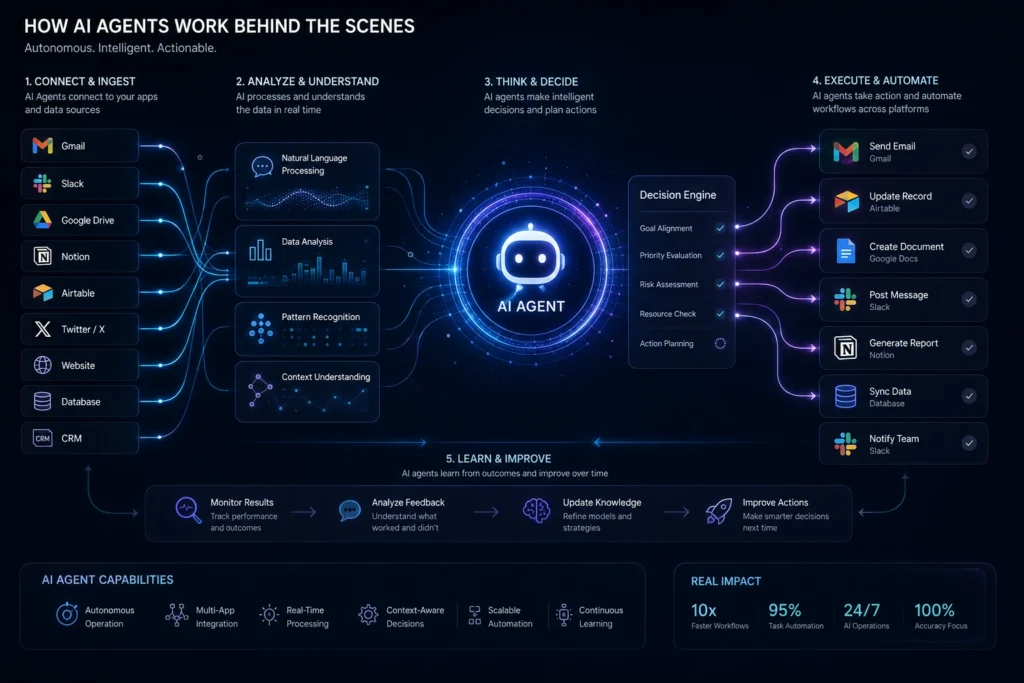
How AI Agents Work Behind the Scenes?
Most AI agents follow a similar process.
Step 1: Understand the Goal
The agent receives an objective.
Example:
“Research the best content ideas for AI creators.”
Step 2: Create a Plan
The system breaks the task into smaller actions.
Step 3: Gather Information
The agent collects relevant data from available sources.
Step 4: Execute Actions
Tasks are completed based on instructions.
Step 5: Evaluate Results
The agent checks whether the goal has been achieved.
This process allows AI agents to handle more complex workflows than standard AI assistants.
Best AI Browser Agents
The internet has become more complex than ever.
Students spend hours researching assignments.
Creators manage content, publishing schedules, and audience engagement.
Freelancers search for leads, clients, and opportunities.
Businesses handle customer inquiries, competitor monitoring, and repetitive online tasks every day.
As digital workloads continue to grow, people need tools that can do more than simply answer questions.
AI browser agents help by:
- Automating repetitive web tasks
- Conducting research across multiple websites
- Collecting and organizing information
- Monitoring competitors and market trends
- Filling forms and completing routine actions
- Improving productivity and saving valuable time

Unlike traditional automation tools, AI browser agents can understand instructions in natural language and adapt to different websites without requiring complex setup.
Many experts believe browser-based AI agents will become an essential part of online work over the next few years.
The goal is not to replace people.
The goal is to eliminate repetitive browsing tasks so users can focus on higher-value work.
If you’re interested in learning how these intelligent systems work, explore our complete guide on AI Browser Agents in 2026: What They Are, How They Work, and the Best Tools to Try.
Real World Use Cases for Creators, Students, and Professionals
For Creators
Creators use AI agents to:
- Research content topics
- Create publishing workflows
- Organize content calendars
- Analyze audience trends
Instead of managing dozens of repetitive tasks manually, creators can focus more on creativity.
For Students
Students often use AI agents for:
- Research assistance
- Study planning
- Note organization
- Project management
The key advantage is better organization rather than simply generating answers.
For Businesses
Businesses use agentic AI tools to:
- Automate customer support
- Manage workflows
- Generate reports
- Organize internal knowledge
Many companies are already testing AI agents as digital team members that handle routine operational work
Common Mistakes People Make With AI Agents
Giving Vague Instructions
AI agents perform better when goals are specific.
Poor instruction:
“Help my business.”
Better instruction:
“Create a weekly report tracking website traffic and email performance.”
Expecting Perfect Results
AI agents still require human oversight.
Reviewing outputs remains important, especially for business decisions.

Automating Everything
Not every task should be delegated.
Creative decisions, strategy, and relationship building often require human judgment.
Best Practices for Using Agentic AI Tools
Start Small
Begin with one workflow.
Measure the results.
Expand gradually.
Monitor Performance
Track:
- Time saved
- Accuracy
- Productivity improvements
- Workflow efficiency
These metrics help determine whether the agent is providing real value.

Keep Human Oversight
The most successful users combine automation with human review.
AI handles repetitive work.
Humans provide direction and final decisions.
Frequently Asked Questions
What are the best AI agent tools in 2026?
Some of the best AI agent tools in 2026 include ChatGPT Operator, Claude, Manus AI, AutoGPT, CrewAI, Microsoft Copilot, and Google Gemini.
What is the difference between AI agents and AI chatbots?
AI chatbots primarily respond to prompts, while AI agents can plan, execute tasks, make decisions, and complete workflows autonomously.
Are AI agents useful for students?
Yes. Students use AI agents for research, organization, study planning, project management, and information analysis.
Which AI agent tools are best for businesses?
Microsoft Copilot, CrewAI, Claude, and Manus AI are commonly used for workflow automation and business productivity.
Can AI agents replace human workers?
AI agents can automate repetitive tasks, but they still require human oversight, decision making, creativity, and strategic thinking.
Conclusion
The best AI agent tools in 2026 are changing how people work, learn, create, and manage information. Unlike traditional AI assistants, modern AI agents can plan tasks, execute workflows, and help users achieve goals with less manual effort.
Whether you are a creator looking to streamline content production, a student managing research projects, or a business improving operations, AI agents offer practical ways to save time and stay organized.
The most effective approach is not to hand everything over to automation. It is to use AI agents as capable assistants while keeping human judgment at the center of important decisions.

Interested in discovering more AI tools, automation guides, and practical technology insights?
Explore more articles on your blog and keep experimenting with new AI workflows. The people who learn how to work alongside AI today will be in a much stronger position tomorrow.